When I ran agile training courses I would often talk about the definition of done. Essentially you want to team to be clear on the expectations of the work they are doing and to define a clear end-state, where the work is complete and value is added.
If I carry this concept into my life outside product development then it would result in a clear understanding of what I am committing to do, so that others are clear on what to expect and so that I clarify my purpose before I act.
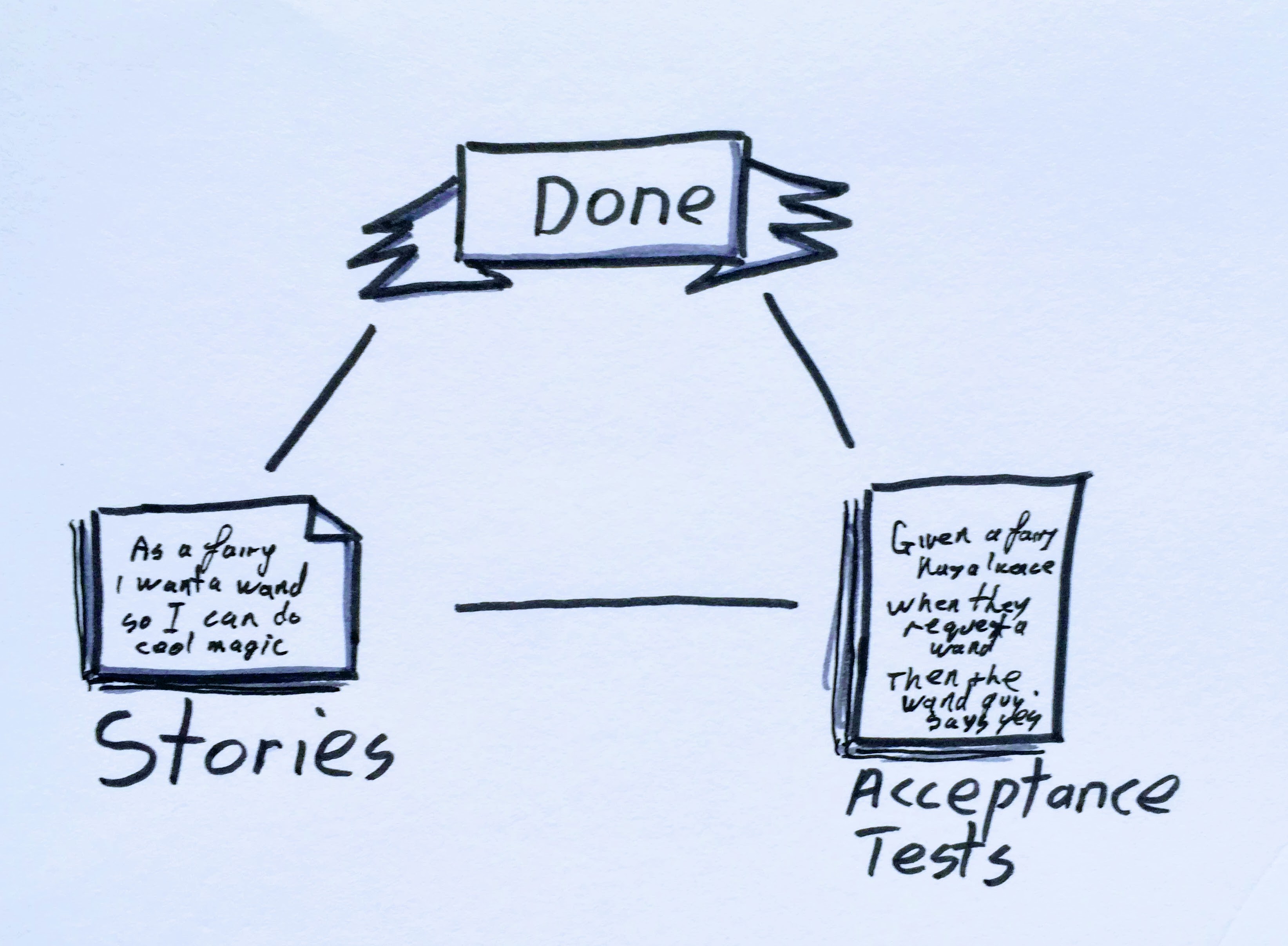
Do I need to define “done” at all?
If I say to my wife that “I will pick up dinner on the way home”, it should be pretty clear that I will arrive home with some food. But in theory there might be confusion:
- I might bring home food for one, for two or for both of us and for the guests that I should have remembered we have visiting today;
- I might assume that salad is a “could do” requirement and not a “should do”;
- I might in theory pick up dinner and eat it on the way home, arriving home full and content; or
- My wife might assume that all dinners come with either chocolate or desert and that anything else is an incomplete meal.
It is probably pedantic to worry too much about this if my wife and I both understand the context and my past behaviour. But there are times where I think giving myself clarity can help.
Greater clarity and purpose
I want to learn more about AI at the moment, so I could set a goal along the lines of “learn more AI”.
A lot of people would tell me that I should make it a SMART goal and say “learn how to use AI tools to apply it to team Scrum-ness by 28 February so I can increase velocity of teams by 11.2%”.
But it is too early for me to be that specific and I expect to learn more about what I want to learn after I start learning. So instead I might set an initial goal like “enroll in some course or listen to some podcast”.
Enrolling in some course is different to completing it though. So I can ask some typical questions to define when I am done:
- What will be different when I am done? How will I know?
- What will still be undone?
- Who will judge whether this is successful? What criteria will they use?
So I can now say that I will complete at least one unit of an online course, write notes on it and determine if I will continue in the course. I will be successful if I learn something I find useful or if my curiousity is piqued and I know what to study next.
That may not sound much different to you but to me it is a far clearer goal to try out.
When talking to others
So asking questions about what “done” looks like is good for goal setting, but what about expectation setting?
I have often found, to my surprise, that people seem to agree on something and then have an argument (or overly polite avoidance of one) later when there is a mismatch in expectations.
While not wanting to turn every favour/request/appointment into a contract, it does sometimes help to clarify the end state before moving forward.
For example I might make an appointment to review your resume for you. But I might think I am really just looking at the grammar, while you think I am helping to refine your job application for AI Product Owner roles.
So I might ask “what will you use the resume for?” or other clarifying questions but still miss out on being clear
- Do you want me to give you comments or to meet again and discuss it in detail?
- Do you want me to review it against a job application or just give you a generic viewpoint?
- What is the next step after I am done?
Then I should probably just say what constitutes the end of “looking at it”. For example – I will send you some general feedback without updating the text – probably by tomorrow afternoon.”
But what about other variants?
Being clear on what will happen helps flush out assumptions and also set clear expectations. Both of these can make life easier. But sometimes I am “kind of done” with things and this can cause me stress.
I am done reading a book when I return it to the library or I get to the acknowledgements at the end of it. But in fact some books sit in my house half read – am I done with them?
Sometimes I am “done for now” which means I will potentially come back to something, but not for a while. In this case I guess I should remove the item from my todo lists because it will just hang around making me feel guilty if I look at the todo item.
So when I say “done for now”, what I should say is “I am done.”
If I feel worried about saying that I am really done, even though the book remains unfinished then maybe I should say “I will be done when I have…”.
This helps when I really should get something more done and I am procrastinating, but it also helps me update my brain to say stop being stressed and say I am actually done. Nothing is depending on me finishing the book, it is just something that I could start again one day.
Another thing that I like to think of is “done enough”. Sometimes I have embarked on things where the end goal is quite ambiguous. For example learning Spanish, or learning AI.
I am still learning to speak English well, so if I wanted to learn Spanish then it could be a commitment of 50 years. But instead I can say “I will have done enough when I can watch a Spanish movie, or when I can list 5 rude words in Spanish”.
Similarly, I often feel guilty if I stop on something I have started, or if me and a friend are continuing with a commitment we made long ago but not getting satisfaction from it.
So I find that sometimes I can say “there is more that can be done – But I have done enough of this now – more effort will not lead to better utility (joy)”. Saying this actually gives me a feeling of freedom.
So “defining done” if good where clarity is really needed, but pausing to think about the end state/success criteria of things is often beneficial beyond that.
While not every conversation is a transaction with a contract attached and not every aspiration needs to be clear before time is spent exploring it, there is value in asking about what “done” means. This includes “done for now = actually done. Start again if you want to later” and “This is enough, lets say we have done enough”.
 James King
Leave a comment